



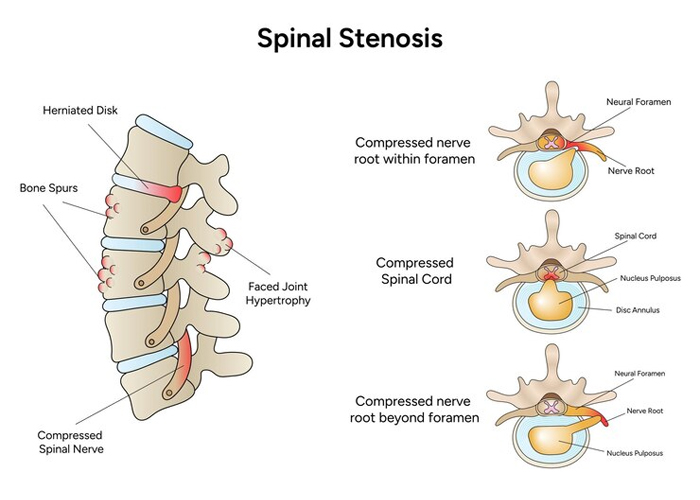
Ankylosing Spondylitis (AS) – also known as axial spondyloarthritis – is an inflammatory disease that can gradually cause fusion of spinal vertebrae. This fusion reduces spinal flexibility and may lead to a stooped posture. If ribs are affected, deep breathing may become difficult.
Ankylosing Spondylitis
As AS progresses, new bone forms as part of the body’s healing response. This bone gradually fills gaps between vertebrae, eventually fusing sections together. Fused vertebrae may straighten the spine’s natural curvature, causing rigidity and forward stooping.
Axial spondyloarthritis has two subtypes:
Ankylosing Spondylitis (Radiographic):
Visible on X-ray imaging.
Non-radiographic Axial Spondyloarthritis (nr-axSpA):
Not detectable on X-ray but diagnosed via symptoms, blood tests, and other imaging (MRI/CT).
Symptoms typically begin in early adulthood (ages 20–40).
Extra-articular manifestations commonly involve ocular inflammation (uveitis/iritis).
While there is currently no cure for AS, treatments can:
Reduce symptoms
Potentially slow disease progression
Symptoms of spinal rheumatism
Early Symptoms of Ankylosing Spondylitis (AS)
Low back pain and stiffness (particularly in the morning or after inactivity)
Buttock/hip discomfort
Neck pain
Fatigue
Symptoms may worsen, improve, or stop at irregular intervals over time.
Commonly Affected Sites:
- Sacroiliac joints
(Junction between spine base and pelvis) - Lumbar vertebrae
(Lower back region) - Entheses
(Sites where tendons/ligaments attach to bone)
Primary: Spinal column
Secondary: Achilles tendon insertion (back of heel) - Costosternal cartilage
(Cartilage between breastbone and ribs) - Large peripheral joints
Hips
Shoulders
Causes of ankylosing spondylitis
While the exact cause remains unknown, genetic factors appear to play a significant role. Specifically, individuals carrying the HLA-B27 gene face increased risk of developing Ankylosing Spondylitis (AS). However, only a subset of HLA-B27 carriers develop the disease.
Risk Factors
Onset typically occurs in late adolescence or early adulthood (ages 17-45).
90% of AS patients are HLA-B27 positive, though most gene carriers never develop AS.
Complications of Advanced AS
In advanced ankylosing spondylitis, new bone forms as part of the body’s attempted healing response. This pathological bone growth gradually fills intervertebral spaces and ultimately fuses vertebral segments. These fused spinal sections become rigid and immobile. The bony fusion may also stiffen the thoracic cage, restricting chest expansion and impairing pulmonary function.
Other complications may include:
- Uveitis (eye inflammation) – one of the most common complications of ankylosing spondylitis – can cause:
Sudden-onset eye pain
Light sensitivity (photophobia)
Blurred vision
Seek immediate medical attention if these symptoms occur.” - Spinal Fractures
Vertebral osteoporosis in early AS can lead to:
Compression fractures
Vertebral collapse → worsening kyphotic posture
Spinal cord/nerve compression (pressure) → potential neurologic damage - Cardiovascular Complications
AS may cause:
Aortitis (aortic inflammation)
Aortic root dilation → aortic valve distortion → regurgitation
Systemic inflammation → 2x increased cardiovascular disease risk
Diagnosis of ankylosing spondylitis
During the physical examination, your physician may:
Ask you to bend in different directions to assess your spinal range of motion.
Apply pressure to specific areas of your pelvis or position your legs to reproduce pain (e.g., Patrick’s test for sacroiliitis).
Request a deep breath to evaluate for restricted chest expansion.
Imaging tests
X-rays allow doctors to examine changes in joints and bones, which is also called radiographic axial spondyloarthritis. However, visible signs of ankylosing spondylitis (also known as axial spondyloarthritis) may not be apparent in the early stages of the disease.
Magnetic resonance imaging (MRI) uses radio waves and a strong magnetic field to provide more detailed images of bones and soft tissues. MRI scans can reveal evidence of non-radiographic axial spondyloarthritis in the early stages of the disease.
Laboratory tests
There is no specific laboratory test to identify ankylosing spondylitis. Some blood tests can check for markers of inflammation, but inflammation can be caused by many different health problems.
Blood can be tested for the HLA-B27 gene. However, many people who have this gene do not develop ankylosing spondylitis, and people without the HLA-B27 gene can still develop the disease.
Treatment of ankylosing spondylitis
The goal of treatment is to relieve pain and stiffness, and to prevent or delay complications and spinal deformity. Treatment for ankylosing spondylitis is most successful before irreversible damage from the disease occurs.
Medications
Nonsteroidal anti-inflammatory drugs (NSAIDs) – such as naproxen sodium and ibuprofen – are the medications doctors most commonly use to treat axial spondyloarthritis and non-radiographic axial spondyloarthritis. These drugs can relieve inflammation, pain, and stiffness, but may cause gastrointestinal bleeding.
If NSAIDs are not helpful, your doctor might suggest starting a tumor necrosis factor (TNF) blocker or an interleukin-17 (IL-17) inhibitor. These medications are injected under the skin or intravenously. Another option is a Janus kinase (JAK) inhibitor. JAK inhibitors are taken orally. This class of drugs can reactivate untreated tuberculosis and increase your susceptibility to infections.
Examples of tumor necrosis factor (TNF) blockers include:
- Adalimumab
- Certolizumab pegol
- Etanercept
- Golimumab
- Infliximab
Interleukin-17 (IL-17) inhibitors used to treat ankylosing spondylitis are secukinumab and ixekizumab.
JAK inhibitors available for treating ankylosing spondylitis include tofacitinib and upadacitinib.
Rehabilitation
Physiotherapy is an important part of treatment and can provide numerous benefits, ranging from pain relief to improved strength and flexibility. A physiotherapist can design specific exercises tailored to your needs. To help maintain good posture, you may be taught:
- Range-of-motion and stretching exercises.
- Strengthening exercises for abdominal and back muscles.
- Proper sleeping and walking posture.
Surgery
Most people with ankylosing spondylitis or non-radiographic axial spondyloarthritis do not require surgery. Surgery may be recommended if you have severe pain or if your hip joint is damaged to the extent that it requires replacement.
If your question is specialized and you require a specialist doctor’s opinion, please visit the homepage of the Iran Rheumatology Center.
Wishing you good health.




No comment